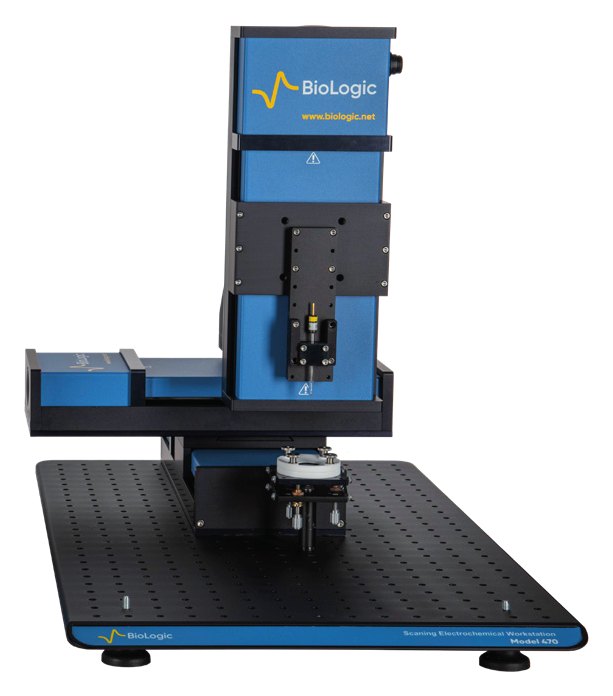
How is height tracking done with the SKP370/SKP470 module?
Keeping the probe-sample distance constant by capacitive height tracking in Kelvin-probe measurement; accuracy on tilted samples.
Sections of the note: Introduction · Principles of CHM and CTM topology measurement. · Topology relief using CHM. · Topology relief using CTM. · Conclusion
Current model: The M370 has been discontinued; the current platform is the M470 (same techniques, 20 nm positioning).
Current model: The current counterpart of the SKP370 module is the M470 SKP470 module.
Scanning Probes – Application Note 2M370 → M470
SECM height correction with OSP: corrosion application
Acquiring the topography with the optical surface profiler and correcting the probe height in the SECM scan; corrosion sample example.
Sections of the note: Introduction · Method. · Results. · OSP measurement · SECM alignment · SECM measurement with topology relief.
Current model: The M370 has been discontinued; the current platform is the M470 (same techniques, 20 nm positioning).
Scanning Probes – Application Note 3M370 → M470
SECM height correction with OSP: sensor application
Removing the topography effect from the activity map of a sensor surface.
Sections of the note: Introduction · Method · Results · OSP measurement · SECM alignment · SECM measurement with topology relief.
Current model: The M370 has been discontinued; the current platform is the M470 (same techniques, 20 nm positioning).
How is area-scan data post-processed and optimised?
Clearer maps through tilt correction, filtering, normalisation and scan-parameter selection.
Sections of the note: Introduction. · A fast CHM measurement. · Conclusions.
Current model: The M370 has been discontinued; the current platform is the M470 (same techniques, 20 nm positioning).
How is image analysis done with the MIRA software?
Microscopic Image Rapid Analysis: 2D/3D surface analysis in approach curves and area scans.
Sections of the note: Introduction · Plotting Data Obtained with M370 Or M470 · Opening files in MIRA · Area Scans · Line Plots · Using the fitting tool
Current model: The M370 has been discontinued; the current platform is the M470 (same techniques, 20 nm positioning).
Current model: The compact SECM150 is not in the current catalogue; SECM measurements are performed on the M470 platform.
Advantages of intermittent-contact (ic) SECM: two corrosion examples
Simultaneous measurement of topography and activity; ic-SECM on tilted and rough corrosion samples.
Sections of the note: Introduction · Principles · Setup description · How is intermittent contact achieved ? · Operation · ac characterization
Scanning Probes – Application Note 7
How are battery electrode materials studied in non-aqueous electrolyte with ac-SECM?
Mapping electrode heterogeneity inside a glove box with ac-SECM, which requires no redox mediator.
Sections of the note: Introduction · ac-SECM · Method · Results · Conclusion
Graphing and analysis tools in the M370/M470 software
Cross-section, statistics, colour-scale and export tools in line/area scans.
Sections of the note: Introduction · Templates · Area Scans · Map Settings · Analysis · Useful Tools for Topography Maps
Current model: The M370 has been discontinued; the current platform is the M470 (same techniques, 20 nm positioning).
Current model: The compact SECM150 is not in the current catalogue; SECM measurements are performed on the M470 platform.
How is a corroded Zn-coated Fe sample imaged with SKP?
Visualising coating damage and galvanic activity with the Kelvin-probe potential map.
Sections of the note: Introduction · Experiment · Results · Conclusion
Scanning Probes – Application Note 10
dc- and ac-SECM measurements on Si nanowire arrays
Comparison of conductivity and reactivity contrast on nanostructured surfaces in the two modes.
Sections of the note: Introduction · dc-SECM vs. ac-SECM · Method · Results · dc-SECM · ac-SECM
How is a nanopatterned gold sample measured with ic-/ac-SECM?
Resolution of sub-micron patterns and separation of the topography contribution by the ic mode.
Sections of the note: Introduction · ic- ac-SECM · Method · Results · Conclusion · Acknowledgements
How is a 3D map produced with 3DIsoPlot?
Rotatable, scalable 3D display of scan data; rendering for posters and presentations.
Sections of the note: Introduction · Samples · Getting Started · Window Menu · Options Menu · 3D Properties
Current model: The M370 has been discontinued; the current platform is the M470 (same techniques, 20 nm positioning).
How is an interdigitated array electrode studied with ic-SECM?
Activity and topography contrast between bands; relationship between probe size and resolution.
Sections of the note: Introduction · Ic-SECM · Method · Results · Conclusion · Acknowledgements
Current model: The M370 has been discontinued; the current platform is the M470 (same techniques, 20 nm positioning).
Introduction to the modular map experiment: interdigitated electrode example
Combining several techniques in a single experiment sequence; external triggering with the USB-PIO.
Sections of the note: Introduction · Using The Modular Map Experiment · Method · Results · Conclusion · Acknowledgements
How is the effect of light on a living leaf measured with the USB-PIO?
Switching the light source synchronously with the scan via the digital I/O module; biological sample example.
Sections of the note: Introduction · Using The USB-PIO · Method · Results · Using the USB-PIO in Sequence · Using the USB-PIO in a Modular Map Experiment
ic-SECM for large topographic features
Maintaining the probe-sample distance on concave, convex and stepped samples.
Sections of the note: Introduction · Why use ic Techniques? · Results · Convex Sample · Concave Sample · Steel Weld
Measurement of mechanically exfoliated graphite with height-tracking SECM
Topography-independent mapping of the reactivity difference between layer edges and basal planes.
Sections of the note: Introduction · Method · Results · Conclusion · Acknowledgements
Current model: The M370 has been discontinued; the current platform is the M470 (same techniques, 20 nm positioning).
Scanning Probes – Application Note 18SECM150 → M470
Micron-scale measurements with the SECM150
Resolution limit on microelectrode arrays with the compact SECM150 (current counterpart: M470).
Sections of the note: Introduction · Method · Results · Tips For Success · Use a Faraday Cage · Select an Appropriate Scan Rate
Current model: The compact SECM150 is not in the current catalogue; SECM measurements are performed on the M470 platform.
Scanning Probes – Application Note 19SECM150 → M470
How is ferricyanide diffusion through porous membranes studied with SECM?
Mapping the species passing through the membrane pores in generation/collection mode.
Sections of the note: Introduction · Method · Results · Quantitative Analysis · Concentration · Collection Efficiency
Current model: The compact SECM150 is not in the current catalogue; SECM measurements are performed on the M470 platform.
Introduction to the Foil Cell: how are foil electrodes measured?
Set-up of the dedicated cell for battery foil electrodes and SECM/ac-SECM measurement.
Sections of the note: Introduction · Advantages Of The Foil Cell · Using The Foil Cell · Results · Membrane · Commercial Battery Electrode Materials
Current model: The M370 has been discontinued; the current platform is the M470 (same techniques, 20 nm positioning).
Scanning Probes – Application Note 21SECM150 → M470
How is an NMC battery electrode measured with the SECM150?
Determination of heterogeneous activity on an NMC electrode with SECM (current counterpart: M470).
Sections of the note: Introduction · Experimental · Results · Conclusion · Acknowledgements
Current model: The compact SECM150 is not in the current catalogue; SECM measurements are performed on the M470 platform.
Vibrating-probe measurements on plants with the SVP470
Mapping ion fluxes at root/leaf surfaces with SVET.
Sections of the note: Introduction · Vibrating Probe Principles · Method · Results · Conclusion
How are bipolar plates studied with ic-SECM?
Coating integrity and local conductivity map on fuel-cell bipolar plates.
Sections of the note: Introduction · Experimental · Results · Conclusion · Acknowledgements
Current model: The compact SECM150 is not in the current catalogue; SECM measurements are performed on the M470 platform.
Sweep-scan mode in SKP experiments
Fast Kelvin-probe maps by continuous scanning instead of stepping; speed-resolution trade-off.
Sections of the note: Video demonstration · Introduction · Sweep vs. step scan · Experimental · Results · Sweep scan vs step scan
Current model: The current counterpart of the SKP370 module is the M470 SKP470 module.
How is the SDS reservoir head used?
Local electrochemistry at the surface with the scanning droplet system; electrolyte-fed head.
Sections of the note: Introduction · Experimental · Results · 1. Trimetallic sample · 2. SKP sample · 3. Weld sample
Height-tracking sweep scan
Combining continuous scanning with height tracking in SKP, SECM and SVET.
Sections of the note: Introduction · Topography Input · 1. Guidelines for file selection. · 2. Aligning OSP for Topography Input · Methods · Results