Corrosion – Application Note 10
How is the corrosion current measured with the Tafel and LPR (Rp) methods?
Corrosion-current determination on an iron electrode in acid solution by Tafel extrapolation and polarisation resistance (Stern-Geary); EC-Lab® Tafel Fit and Rp Fit tools.
Sections of the note: Introduction · Experimental Conditions · Protocol Description · Stern Method (Tafel Fit) · Stern and Geary Method (Rp Fit) · Conclusion
Corrosion – Application Note 22VMP3 → VMP-3e
How is rebar corrosion in reinforced concrete monitored electrochemically?
Rp and EIS measurement on steel in concrete, ohmic-drop correction due to the high resistance and long-term monitoring with the VMP3 (today VMP-3e).
Sections of the note: Introduction · Experimental Conditions · Results · Calculation of Polarization Resistance · Realkalization · CHARACTERIZATIONS OF THE METALLIC ROD.
Current model: The VMP3 has been discontinued; its current counterpart is the 16-channel VMP-3e.
Corrosion – Application Note 25SP-150 → SP-150eSP-50 → SP-50eVMP3 → VMP-3eVSP → VSP
How is pitting corrosion evaluated on multiple samples?
Pitting and repassivation potentials by cyclic polarisation; parallel sample testing with a multichannel instrument (VMP3/VSP → VMP-3e/VSP-3e).
Sections of the note: Introduction · Experimental Conditions · Results · LP Investigations · MPP Investigations and Statistics · Conclusion
Current model: The SP-150 has been replaced by the SP-150e.
Current model: The SP-50 has been replaced by the SP-50e.
Current model: The VMP3 has been discontinued; its current counterpart is the 16-channel VMP-3e.
Current model: The VSP is still available in the Essential range; for energy applications the VSP-3e is recommended.
How are Rp and the Tafel coefficients determined with the VASP technique?
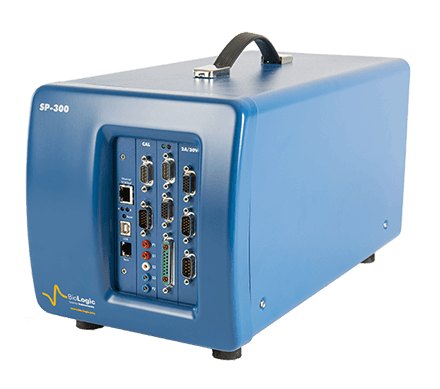
Rp, βa and βc in a single measurement with variable-amplitude sinusoidal polarisation (VASP); application with the SP-300 and comparison with classical methods.
Sections of the note: Introduction · Experimental setup · Results · Conclusion
Corrosion AN37
How is Rp determined with the CASP technique?
Calculation of corrosion parameters from the harmonics of constant-amplitude sinusoidal polarisation (CASP). (The source file was downloaded incorrectly; the summary will be completed when it is re-supplied.)
Electrochemical noise measurement 1: How is instrument noise validated according to ASTM?
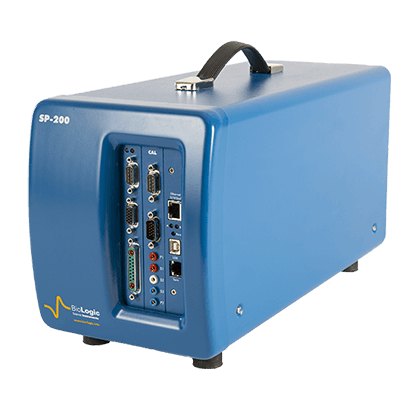
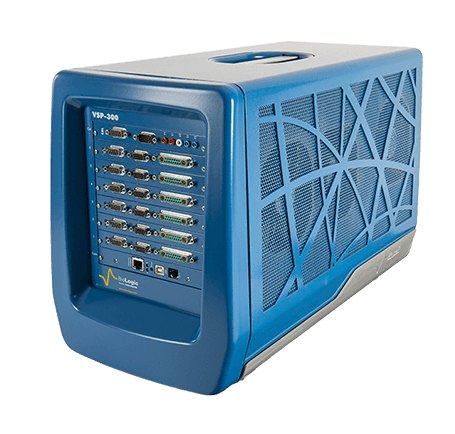
Measurement of the instrument noise floor with a dummy cell under ASTM G199; noise performance of the SP-200/SP-300/VSP-300 and the ULC option.
Sections of the note: Introduction · ASTM Requirements · Experimental Setup · Results · Conclusion · Appendix
Current model: The SP-240 has been discontinued; its current counterpart is the SP-300.
Electrochemical noise measurement 2: ASTM evaluation on a real system
Noise recording in ZRA mode in a real corrosion cell, data processing and ASTM evaluation of results obtained with the VSP-300.
Sections of the note: Introduction · ASTM Experiment · ASTM Comparison · Conclusion · Appendix
Electrochemical noise measurement 3: How is the noise resistance Rn calculated?
Rn determination from the standard deviations of potential and current noise, its relationship with Rp and use of the EC-Lab® ENA tool.
Sections of the note: Introduction · Experimental Conditions · Impedance Measurement · Noise Measurements · Results · Impedance Measurement
Current model: The SP-240 has been discontinued; its current counterpart is the SP-300.
Corrosion – Application Note 47
How is the corrosion current determined under mass-transfer-limited corrosion?
In oxygen-reduction-limited systems the Stern relation does not hold; the note gives the appropriate fit model in EC-Lab® and the interpretation of the results.
Sections of the note: Introduction · Corrosion with mass transfer limitation · I vs. E Relationship · Dummy cell · Stern method (Tafel fit) · Stern and Geary method
Corrosion – Application Note 48
How much does ohmic drop mislead corrosion-current determination?
How uncorrected IR drop distorts Tafel slopes and Icorr; the effect of correction with ZIR with numerical examples.
Sections of the note: Introduction · Ohmic drop · Corrosion current measurement in presence of an ohmic drop · ZIR Technique · STERN Method (TAFEL Fit) · Stern and Geary method