Fuel Cell AN11
How is the electrochemically active surface area (ECSA) of a platinum catalyst calculated?
ECSA calculation from hydrogen adsorption/desorption charges; CV on an RDE and the EC-Lab® integration tool.
Sections of the note: Introduction · Experimental Conditions · Protocol Description · Calculation of the Active Surface · Conclusion
Fuel Cell AN31
Fuel cell testing 1: How is the polarisation (I/E) curve recorded and interpreted?
Activation, ohmic and mass-transfer regions; constant-current/constant-voltage sweep protocols and the fuel-cell test set-up with EC-Lab®.
Sections of the note: Introduction · Set-up description · Gas and water management · Presentation · Safety parameters · Humidity calculator tool
Fuel Cell AN32
Fuel cell testing 2: How is characterisation done with EIS?
Galvano-EIS at operating points; separation of membrane resistance, charge-transfer and diffusion contributions and Z Fit models.
Sections of the note: Introduction · Set-up description · Impedance characterization · EIS data fitting · Data importation from FC-Lab® to EC-Lab® · ZFIT
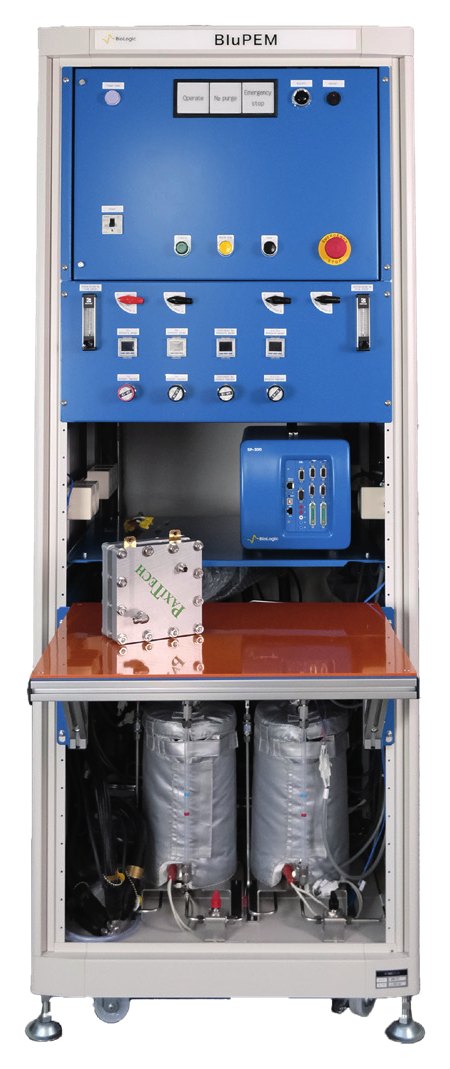
How are high-current DC and EIS measurements done on a PEM electrolyser?
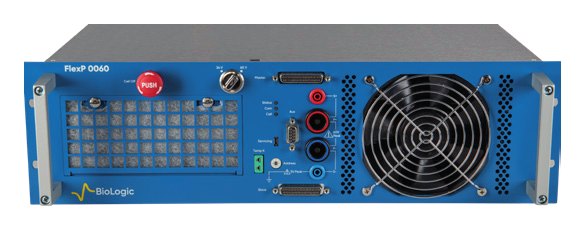
Polarisation and EIS up to 200 A through the SP-150e with a FlexP booster; connection, safety and software settings.
Sections of the note: Introduction · Experimental set-up · Measuring hardware · The electrolyzer · Safety considerations · Data discussion
Current model: The SP-150 has been replaced by the SP-150e.
How is a vanadium redox flow battery (VRFB) characterised in DC and AC?
Charge/discharge, polarisation and EIS in a Pinflow 20 cm² test cell with the VSP-300 and BCS-815; effect of flow rate and SOC on impedance.
Sections of the note: Introduction · VRFB principles · Experimental conditions · Results · Charge to +50% SoC · Cycling
Current model: The BCS-815 has been replaced by the BCS-915.