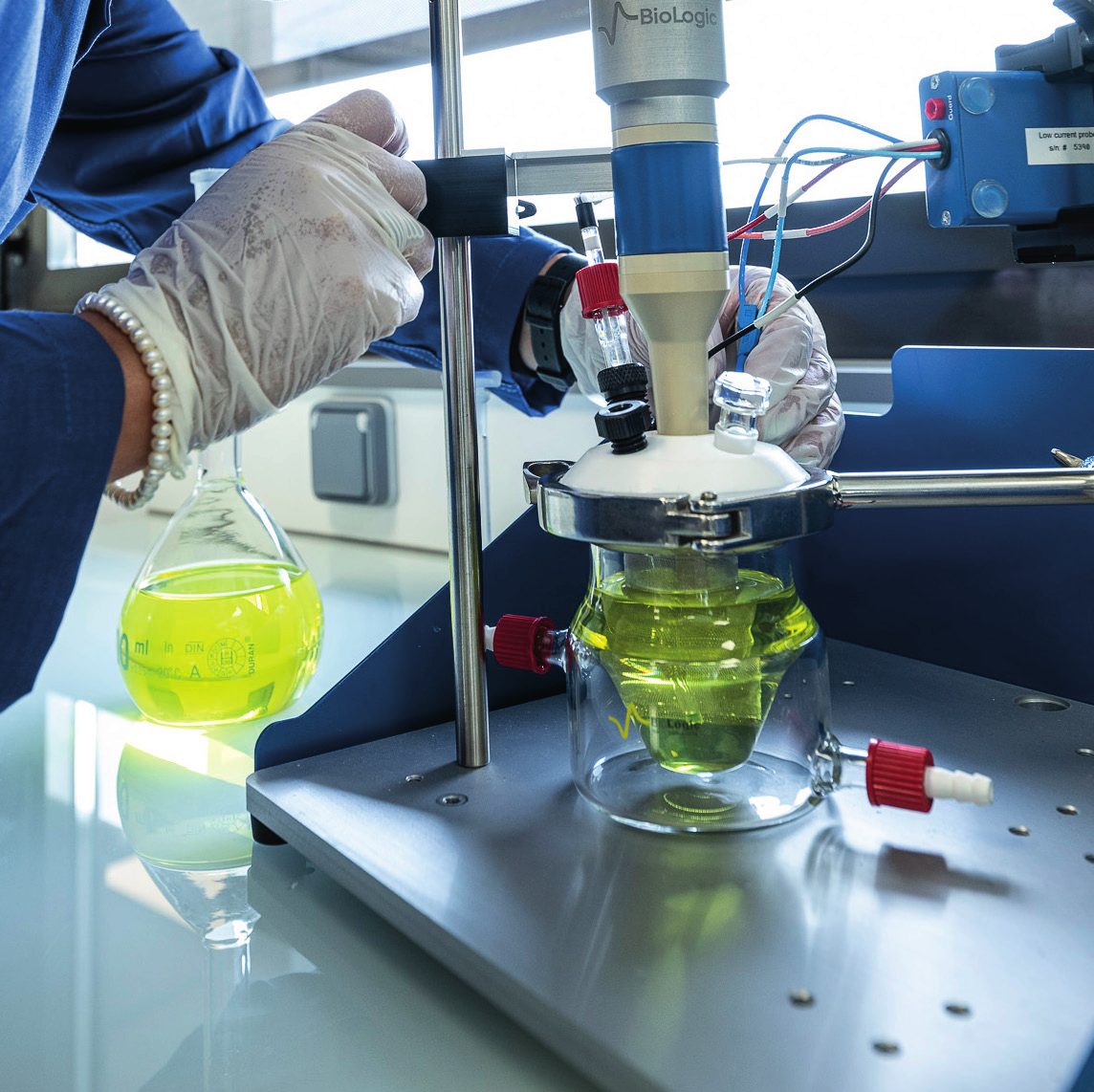
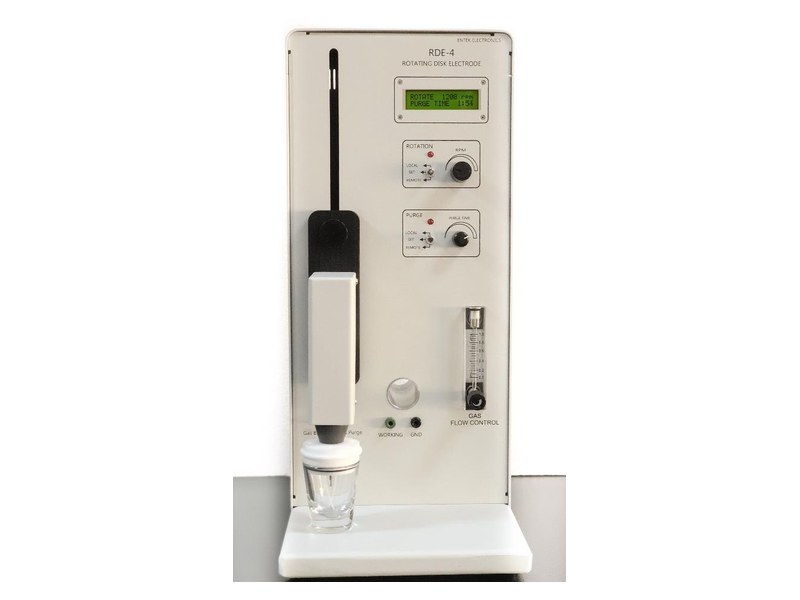
How is a rotating ring-disk electrode (RRDE) experiment done with a bipotentiostat?
Synchronous operation of the two channels of the SP-300/VSP-300/VMP-300 in bipotentiostat mode; ring collection efficiency and ORR examples.
Sections of the note: Introduction · Description and Principle · Experimental Part · Results · Conclusion
Current model: Legacy VMP series; current counterparts are the VMP-3e / VMP-300.
Electrochemistry – Application Note 12
How is electrochemistry coupled with UV-Vis spectroscopy (spectroelectrochemistry)?
Potential-dependent absorbance of a polypyrrole film; spectrometer triggering and data synchronisation with EC-Lab®.
Sections of the note: Introduction · Experimental Part · Electropolymerization · Spectro-Electrochemistry · Results and Discussion · Conclusion
Electrochemistry – Application Note 13
How is mass measured during film deposition with QCM coupling?
Mass-charge relationship with EQCM during polypyrrole electropolymerisation; Sauerbrey equation and analogue-input synchronisation.
Sections of the note: Introduction · Experimental Part · Electropolymerization · Mass Variation Measurements · QCM Input Signal Configuration in Ec-Lab® · Results and Discussion
Current model: For the BluQCM product group, please consult Entek.
Corrosion – Application Note 21VSP → VSP
How is the double-layer capacitance measured?
Comparison of Cdl determination by CV, EIS and current step; moving on to true surface area and roughness factor.
Sections of the note: Introduction · Experimental Conditions · Impedance Theory · Impedance Results and Analysis · Cyclic Voltammetry Results And Analysis · Conclusion
Current model: The VSP is still available in the Essential range; for energy applications the VSP-3e is recommended.
Kinetics AN41-1
CV Sim 1: How does the scan rate affect the voltammogram of a simple redox reaction?
Simulation of reversible/quasi-reversible/irreversible behaviour; peak separation and the relationship between peak current and scan rate.
Sections of the note: Introduction · Definitions · Description of CVSim · Kinetic study of the (E) redox reaction using variable scan rates · The reversible (or Nernstian) behaviour · The irreversible behaviour
Kinetics AN41-2
CV Sim 2: How do ohmic drop and double-layer capacitance distort the voltammogram?
The effect of IR drop on peak shift and of Cdl on capacitive current by simulation; reference curves for interpreting experimental data.
Sections of the note: Introduction · Background · The double layer capacitance · Electrolyte resistance and the ohmic drop · Effect of Cdl · Effect of RΩ
Spectroelectrochemistry AN52
How is UV-Vis, NIR and IR spectroelectrochemistry done with the UFS-SEC cell?
Structure of the thin-layer spectroelectrochemical cell, electrode options and in-situ measurement examples with EC-Lab®.
Sections of the note: Introduction · Experimental considerations · Measurement · General considerations · UV-Visible · Infrared
How is reaction kinetics measured with Levich and Koutecký-Levich analyses?
RDE voltammetry with the BluRev rotator; diffusion coefficient, electron number and kinetic constant with the EC-Lab® Levich and K-L tools.
Sections of the note: Introduction · ROTATING DISK ELECTRODE EXPERIMENT: LEVICH CRITERION · AIM AND PRINCIPLES · EXPERIMENT · ANALYSIS · ROTATING DISK ELECTRODE EXPERIMENT: KOUTECKÝ-LEVICH EXTRAPOLATION
EIS on an RDE 1: How is the diffusion coefficient determined with the new Winf element?
Convection-diffusion impedance on a rotating disk; extraction of the diffusion coefficient with the Winf element in Z Fit.
Sections of the note: Introduction · EXPERIMENTAL CONDITIONS · ELECTROLYTE · SET-UP · RESULTS · ANALYSIS
Current model: Legacy VMP series; current counterparts are the VMP-3e / VMP-300.
How are pulsed techniques (SWV, DPV, NPV) used in sensors and electroanalysis?
Principles of square-wave, differential-pulse and normal-pulse voltammetry, parameter selection and trace-analysis examples in EC-Lab®.
Sections of the note: Introduction · THEORETICAL DESCRIPTION · 1 NPV (NORMAL PULSE VOLTAMMETRY) · 2 DPV (DIFFERENTIAL PULSE VOLTAMMETRY) · 3 SWV (SQUARE WAVE VOLTAMMETRY) · EXPERIMENTAL CONDITIONS
Current model: The VMP3 has been discontinued; its current counterpart is the 16-channel VMP-3e.