
How does EIS (electrochemical impedance spectroscopy) work?
Small-amplitude AC excitation, Nyquist/Bode representation, equivalent-circuit modelling and the three indicators that validate measurement quality.
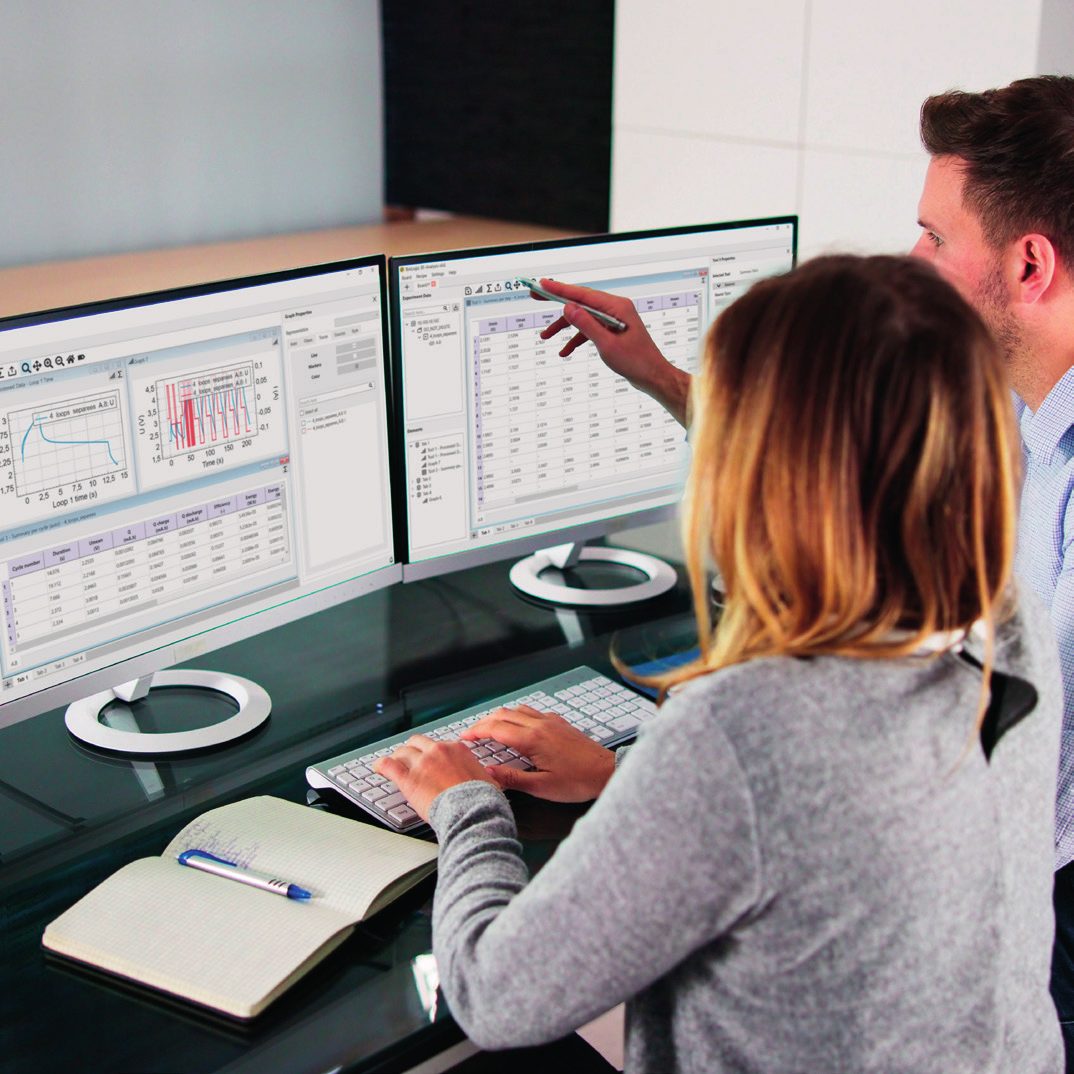
In EIS a small-amplitude sinusoidal potential (PEIS) or current (GEIS) excitation is applied to the system over a frequency range (from 10 µHz to 11 MHz on Bio-Logic instruments) and the frequency-dependent impedance Z(ω) is calculated from the amplitude ratio and phase shift of the response. Results are displayed as Nyquist (−Im Z vs Re Z) and Bode (|Z| and phase vs frequency) plots.
What do we learn?
High frequencies reflect the solution/internal resistance and inductive behaviour, mid frequencies the interfacial processes (double-layer capacitance, charge-transfer resistance, SEI), and low frequencies diffusion and insertion processes. SOC/SOH tracking and degradation mechanisms in batteries, coating resistance and capacitance in corrosion, and conductivity and dielectric relaxation in materials are determined this way.
Equivalent-circuit modelling
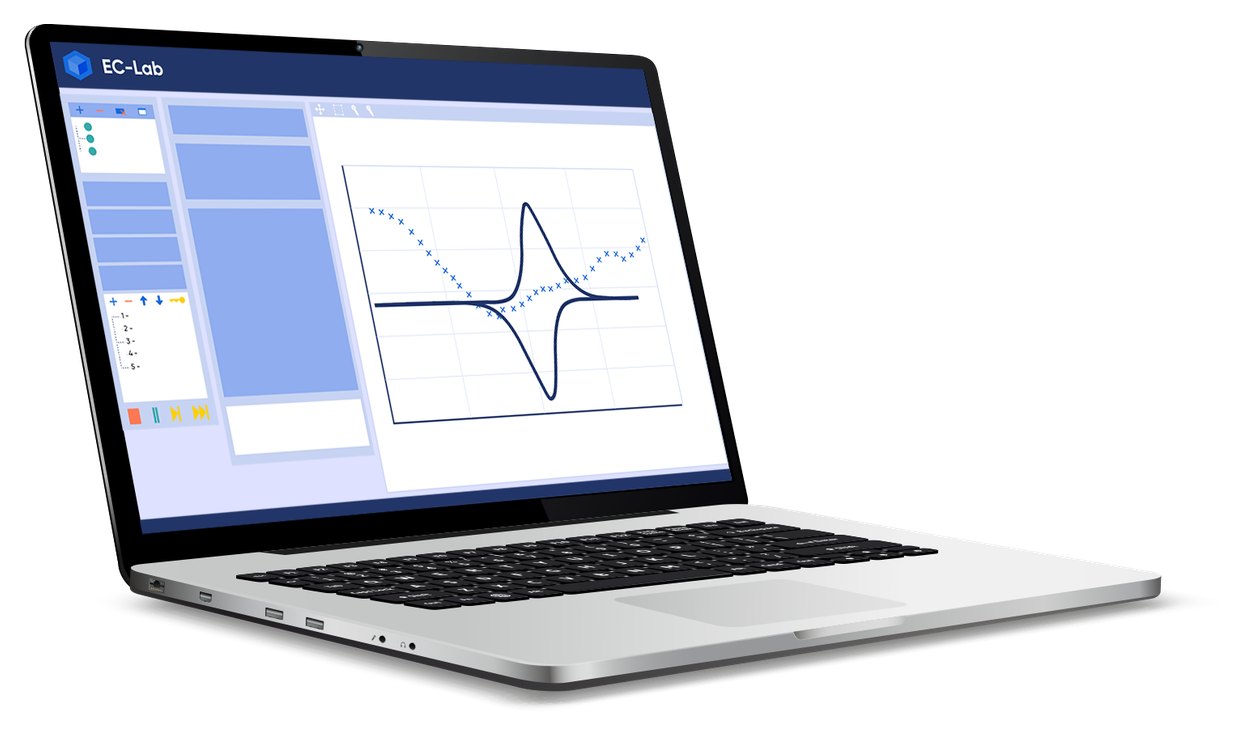
EC-Lab® Z Fit models experimental data with more than 150 predefined circuits and 14 elements (R, C, L, Q, W, G, Wδ, Winf, M, Gα, Gβ, Lα, Mα, Mγ); batch processing fits all cycles of an experiment automatically. Cable effects are corrected with the compensation tool; the Kramers-Kronig test checks the consistency of the data.
Is the measurement reliable? EIS Quality Indicators
A valid EIS measurement requires the system to be linear, stationary and free of noise. Three indicators specific to EC-Lab® quantify this: THD (total harmonic distortion; increases if the amplitude is too large → reduce the amplitude), NSD (non-stationary distortion; increases if the system is not yet stable → increase the waiting time) and NSR (noise-to-signal ratio; increases if the output signal is too small → increase the amplitude). Generally accepted: THD < 5%.
Sources: Bio-Logic 2026 product catalogue and product brochures; general electrochemistry literature. This content is for information; consult our technical team for instrument selection.